Digital guide · Instant download · 60-day guarantee. A step-by-step DIY manual, blueprints and video guides that teach you how to pull drinking water out of humid air with a home-built atmospheric water generator — plus an honest look at what it can and cannot realistically produce, so you can decide with your eyes open before you spend a cent on parts.
The Water Freedom System is a digital do-it-yourself guide that teaches you how to build an atmospheric water generator — a machine that pulls water vapour out of humid air, condenses it into liquid water, filters it, and stores it for use. The idea is not new: the same principle runs inside every dehumidifier and air conditioner you have ever owned, both of which quietly collect litres of condensed water every day and throw it away. This guide simply turns that familiar process into a deliberate, purpose-built device, with a fan, a cooled surface, a collection reservoir and a filtration chain, so that the water it produces is handled, filtered and stored as drinking water rather than drained away as waste.
The pitch behind the guide is a simple one. Municipal water supplies can be interrupted by drought, infrastructure failures, contamination scares or natural disasters, and bottled water is expensive, heavy to store and finite. A machine that makes its own water from the air, the sales page argues, offers a measure of independence from all of that — a backup source you control, built from ordinary parts, in about an hour, for under $200 in parts according to the vendor. Independent reviewers who have examined the guide put the realistic parts cost higher, in the region of $200–$400 depending on where you buy and what you already own, and that gap matters: it is the difference between a weekend project and a more serious investment, and you should budget for the higher figure before you commit.
What you actually receive is entirely digital unless you choose the optional printed book. The package is a PDF manual with step-by-step instructions, diagrams and blueprints, a parts list with material-sourcing guidance, instructions for sediment and activated-carbon filtration, over-the-shoulder video guides that walk through the build, illustrated instructions, a materials cheat sheet, and unlimited email support. Nothing physical ships with the digital package. An optional physical book version is available for the same guide price plus $9.95 shipping and handling, for readers who prefer a printed copy on the workbench. The guide is marketed under the name Chris Burns, described as a Fresno farmer, while the current sales page says the author writes under the pen name Richard Wilson, and support is reached at richard@waterfreedomsystem.com.
This page is an independent informational and affiliate page, not the official sales page, and it takes a deliberately honest approach to a product whose marketing makes very large claims. The vendor’s headline promise — up to 60 gallons of clean water a day, even in the desert — is reported here as a vendor claim only, and the sections below explain, with numbers, why that figure does not hold up as a realistic expectation for a home-built unit. The guide may still be useful to the right person, in the right climate, with the right expectations: a DIY-minded reader in a humid climate who wants a backup water source and understands that output depends entirely on humidity, temperature and power. Read the honest assessment, the water-safety section and the buying-safety notes before you decide, and if you do decide to buy, confirm the price, the payment terms and the guarantee at checkout, because those are set by the vendor and ClickBank, not by this page.
The Water Freedom System is built around one well-understood piece of physics: cool humid air below its dew point and the water vapour in it condenses into liquid. The guide walks you through that process in five practical stages, from air intake to safe storage.
Everything starts with moving air. A fan pulls warm, humid air from the room or the outdoors into the generator and across its internal surfaces. The amount of water available in that air is set entirely by the weather: warm, humid air can hold a surprising amount of water vapour, while cool, dry air holds very little. This is why the same machine can be productive on a muggy summer evening and nearly useless on a dry winter afternoon, and why the guide’s output depends far more on your local climate than on how carefully you follow the instructions. The fan’s job is simply to keep a steady stream of fresh humid air moving across the cold surface, because still air quickly gives up its moisture and then produces nothing more.
Inside the unit, the incoming air passes over a surface cooled below the dew point — the temperature at which water vapour turns back into liquid. Cooling is usually done with a refrigeration-style coil or a thermoelectric cooler, and it is the most energy-hungry part of the whole system. As the air cools, droplets of water form on the cold surface, just as they do on the outside of a cold glass on a humid day. The colder the surface relative to the dew point, and the more humid the incoming air, the faster condensation forms; when the air is dry, the dew point is low, the surface must be cooled much further, and the energy cost climbs while the yield falls away.
The condensed droplets run off the cold surface and drain by gravity into a collection container or reservoir. This sounds trivial, and in a well-built unit it mostly is, but the details matter more than they appear to: the collection path must be made from food-grade materials, the reservoir must be covered so that dust, insects and airborne contaminants cannot fall in, and the whole path must be cleanable, because any damp surface left warm and undisturbed becomes a place where biofilm and mould can grow. The guide’s diagrams cover the layout of this stage, and the water-safety section below explains why the materials and the cleaning routine deserve as much attention as the cooling itself.
Condensed water is not automatically safe drinking water, however clean it looks. The guide includes instructions for a treatment chain built around sediment filtration, which removes visible particles, and activated-carbon filtration, which helps with taste, odour and some dissolved chemicals. That is a starting point, not a complete treatment system: because the water has condensed out of ordinary air, it needs a microbiological barrier as well, such as ultrafiltration or ultraviolet disinfection, or boiling, before it should be treated as drinking water. The filtration stage is where the difference between a science project and a water source is decided, and the full treatment chain is spelled out in the water-safety section further down this page.
The final step is storage and verification. Filtered water should be kept in clean, food-grade containers, kept cool and out of sunlight, and used within a reasonable time rather than left standing for weeks. Just as important, the early batches from any home-built unit should be tested — by a laboratory or your local water authority — before you rely on the water for drinking, because no diagram or parts list can guarantee what your particular build, in your particular air, actually produces. Testing is the only way to know whether your filtration chain is doing its job, and it is the step most often skipped by enthusiastic builders. Do not skip it.
Eight honest benefits — what the guide genuinely offers, and where its limits lie, stated plainly alongside each one.
The most genuine benefit of the guide is independence: a working atmospheric water generator gives you a second source of water that does not depend on the mains supply, a delivery truck or a shop shelf. In a power cut the machine stops too, so it is not a complete answer to every emergency, but during a boil-water notice, a supply interruption or a period when stored water has run out, a home-built unit in a humid climate can help bridge the gap. Think of it as one layer in a wider preparedness plan — alongside stored water, a good filter and a way to boil water — rather than a replacement for all of them.
Building the generator teaches real, transferable skills: how condensation and the dew point work, how to size a fan and a cooling element, how to plumb a collection path, and how filtration stages fit together. Those skills carry over into other projects, from improving a dehumidifier setup to understanding how your air conditioner handles moisture. For readers who learn by doing, the guide’s step-by-step structure, diagrams and over-the-shoulder videos are the core value of the package, and they remain useful even if the finished machine ends up as an occasional-use backup rather than a daily water source.
Humid air is a water source that most homes simply ignore: air conditioners and dehumidifiers pull litres of it out of the air every day and send it down a drain. An atmospheric water generator puts that same overlooked resource to deliberate use, and in a humid climate there is genuinely a lot of it — a single warm, muggy day can hold far more water in the air above a house than most people realise. The catch, and it is a large one, is that harvesting it costs energy, and the yield falls sharply as humidity drops. The resource is real; the economics of collecting it are what you must judge honestly.
In genuinely humid conditions — above roughly 60% relative humidity — an atmospheric water generator can produce a useful amount of water, and purpose-built residential units typically make 2 to 10 gallons a day in those conditions. That is enough to matter: drinking and cooking water for a household, or a meaningful supplement to stored supplies. Between about 40% and 60% humidity the output becomes patchy and unpredictable, and below 40% it drops to a trickle that is rarely worth the electricity. If you live somewhere humid for much of the year, the guide has a real use case; if you live somewhere dry, it does not, whatever the sales page says about the desert.
Nothing in a home-built atmospheric water generator is exotic. The build uses a fan, a cooling element, tubing, a collection container and filtration components — parts that can be sourced from hardware stores and online suppliers without specialist knowledge or a specialist supplier. The guide’s parts list and material-sourcing guidance exist precisely to take the guesswork out of that shopping trip, and the materials cheat sheet is designed to be carried into a store or kept open on a phone while ordering. That ordinariness is a genuine strength: if a part fails, you can usually replace it locally instead of waiting for a proprietary spare.
Written instructions alone can leave a builder guessing at the exact moment a diagram goes ambiguous — which way a fitting turns, how tight a connection should be, what a finished joint should look like. The over-the-shoulder video guides included with the package are meant to close that gap by showing the build as it happens, step by step, so you can pause, rewind and compare your work with what is on screen. For a first-time builder, that visual reassurance is often the difference between a finished machine and a half-built box of parts in the garage, and it is one of the strongest parts of the package.
The guide’s filtration instructions — sediment filtration followed by activated-carbon filtration, plus the disinfection step this page insists on — teach a treatment chain that applies far beyond this one machine. The same sequence of removing particles, improving taste and odour, and then dealing with micro-organisms is the backbone of most household water treatment, from camping filters to rainwater systems. Even if you never build the generator, understanding that chain, and why each stage exists, makes you a more capable judge of any water filter you buy or any emergency water claim you hear.
The guide is sold through ClickBank with a 60-day money-back guarantee, which lowers the risk of trying it considerably. You can buy the digital package, read the manual, watch the videos, judge the diagrams and the parts list for yourself, and ask for a refund through ClickBank within 60 days if the content does not match what was promised. That guarantee does not cover the cost of any parts you buy, and it does not make a bad fit into a good one — but it does mean the guide itself can be evaluated before you spend anything on hardware, which is the sensible order of operations: read first, build second.
Six components, all digital in the standard package. No doses, no capsules, no supplements — this is a build manual, and its contents are instructions, diagrams and video, not ingredients.
The core of the package: a full blueprint for the atmospheric water generator, taking you from a pile of parts to a working machine. The blueprint sets out the layout, the order of assembly and the way each stage connects to the next, so that a reader with basic DIY confidence can follow it without having designed anything themselves. It is the document you will return to most during the build, and the one to read end-to-end before ordering a single part.
Detailed diagrams and illustrated instructions accompany the written steps, showing how the fan, the cooling surface, the collection path and the filtration stages fit together. A good diagram answers in seconds the questions that paragraphs struggle with — where a tube runs, which side of a fitting faces up, how the reservoir sits relative to the coil — and for a project where a wrong connection means water on the floor instead of in the tank, that clarity is practical, not decorative.
A complete parts list with material-sourcing guidance, telling you what to buy and where to look for it, plus a materials cheat sheet designed for quick reference while shopping. The vendor’s pitch says the build costs under $200 in parts; independent reviewers who have examined the guide estimate $200–$400 in practice, so budget for the higher figure and treat the parts list as a shopping list to price before you commit, not as a promise of a fixed total.
Instructions for the treatment chain: sediment filtration to remove particles, followed by activated-carbon filtration for taste, odour and some dissolved chemicals. The guide presents this as the filtration stage, and this page adds an essential qualification: add a microbiological barrier — ultrafiltration or UV disinfection, or boiling — before treating the output as drinking water, because sediment and carbon alone do not make condensed water microbiologically safe.
Video guides that walk through the build as it happens, so you can watch each step being done rather than interpreting it from text alone. Pause, rewind and compare your work with the screen. For first-time builders this is often the most-used part of the package, and it is worth watching the full set once before you start, so that you understand the whole build before you pick up a tool.
Unlimited email support is included with the package, reached at richard@waterfreedomsystem.com. If a step in the manual is unclear, a part does not match the list, or the build behaves differently from the description, support is the channel to ask. Keep your order details and a clear description of the problem — and a photo, where relevant — in your first message, and remember that refund requests go through ClickBank, not through the vendor’s support email.
No diagram or parts list is shown before purchase, so the contents above are as described on the official sales page and in independent reviews of the guide — verify the exact contents on the sales page at checkout. The digital package contains no physical product; only the optional printed book ships, for $9.95 shipping and handling.
This guide suits a specific kind of reader in a specific kind of climate. If that is you, it may be genuinely useful; if it is not, the honest answer is to spend your money on stored water and a good filter instead.
If you enjoy building things, you live somewhere humid for much of the year, and you like the idea of a project that also produces something useful, this guide is aimed squarely at you. Above roughly 60% relative humidity the physics is on your side, the output can be genuinely useful, and the build itself is a satisfying weekend project. Check your local humidity across the seasons before buying, not just on a muggy afternoon in August.
If you are building a layered preparedness plan and want one more source beyond stored water, this guide adds a skill and a machine to that plan. Treat it as a supplement to stored water, a portable filter and a way to boil water — not as a replacement for any of them — and remember that the generator needs electricity, so pair it with a plan for power as well, or it will sit idle in exactly the emergency you bought it for.
If you are learning off-grid skills, studying how water systems work, or simply curious about atmospheric water generation, the guide is a structured way into the subject, with a finished machine at the end of it. The knowledge transfers to other water projects, and the build is a good way to test whether atmospheric water generation deserves a place in your longer-term plans before investing in a commercial unit.
If you are the kind of buyer who reads the fine print, checks the claims and wants the catch stated upfront, this page is written for you — and the guide itself should be judged the same way. Read the manual first, price the parts, check your humidity, and use the 60-day guarantee window to decide. A careful buyer who ends up not building is still a good outcome if the alternative was an impulsive purchase.
An honest boundary: this guide is not a household water supply. It will not replace your mains water, it will not produce the vendor’s headline figure of 60 gallons a day from a home-built unit, and it will not work well in a dry climate — below about 40% relative humidity the output is a trickle. If you live somewhere dry, if you need large volumes of water every day, or if you want drinking water without any building, testing or maintenance, this is the wrong product for you. Stored water, a quality portable filter or purifier, and rainwater harvesting are all likely to serve you better, and the comparison section below sets them side by side so you can judge for yourself.
A realistic timeline, matched to the 60-day guarantee window. The guarantee deadline is the date that matters most — make your decision before it passes, not after.
Read the manual end-to-end and watch the video guides before buying anything. Judge the diagrams, the parts list and the filtration instructions on their own merits, check the humidity in your area across the seasons, and decide whether the project fits your climate and your skills. This is the week to be sceptical — it costs nothing, and it is the cheapest week of the whole project.
Price the full parts list from the suppliers you would actually use, and compare the total with the vendor’s under-$200 pitch and the independent estimate of $200–$400. Order the parts, the food-grade tubing and containers, and the filtration components, including the microbiological barrier the guide’s own filtration stage does not fully cover. If the real total changes your mind, you have spent nothing you cannot return.
Build the unit following the blueprint and videos, working in the order the guide sets out and checking each stage before moving on: fan and air path first, then the cooling surface, then collection, then filtration. The vendor suggests about an hour for the build; first-time builders should allow a relaxed weekend instead, because careful fitting, leak-checking and cleaning take longer than the optimistic estimate, and rushing is how water ends up on the floor.
Run the finished unit in your real conditions and measure what it actually produces over several days, in different weather, rather than trusting a single good afternoon. Log the humidity, the run time and the volume collected, and send early batches for laboratory testing or check with your local water authority before drinking any of it. This is the evidence that tells you whether the machine earns its running cost in your home.
Work out the real cost per litre: the electricity the cooling stage uses, the replacement schedule for filters and carbon, and the time spent cleaning the coil and reservoir. Efficient commercial units need roughly 0.4 kWh per litre, so compare your measured yield against your electricity price and against the cost of stored or filtered water. If the numbers do not work in your climate, that is useful knowledge — and it is better learned in week eight than in month eight.
Day 60 is the end of the ClickBank money-back guarantee on the guide. If the manual, the diagrams and the build did not deliver what was promised, request the refund through ClickBank before this date — not through the vendor’s support email, and not the day after. Mark the date in your calendar on the day you buy, so the decision is made deliberately and on time.
No single option wins on every measure. Here is how a home-built atmospheric water generator stacks up against the alternatives most readers are already considering.
A DIY atmospheric water generator built from the guide’s blueprint: fan, cooled surface, collection reservoir and filtration. Strengths: a renewable source in humid air, ordinary parts, a useful skill learned along the way, and a backup that does not depend on shops or deliveries. Weaknesses: output collapses in dry air, the energy cost is high per litre, the build takes time and testing, and the water needs a full treatment chain before drinking. Best for: humid-climate DIY readers who want a backup source and understand the limits. The vendor’s headline claim of up to 60 gallons a day is not a realistic expectation for a home-built unit — purpose-built residential units typically make 2–10 gallons a day at high humidity, and a year-long field study of a commercial unit recorded a best day of 29.8 litres, under 8 gallons, with zero on drier days.
Bottled or tanked water, bought and stored in advance. Strengths: no electricity needed, no building, no testing, and the water is ready the moment you need it — which is exactly what matters in an emergency. Weaknesses: it takes up space, it is heavy, it has a shelf life, and once it is gone it is gone until you can buy more. Best for: every household, as the first layer of any water plan, whatever else you add. Stored water and a home-built generator are complements, not competitors: store water for the first days of an emergency, and use a generator, where the climate allows, to extend the supply after that.
A proven portable filter or purifier for treating water from taps, streams, rain or other sources. Strengths: immediate, tested performance, no power needed for gravity and pump models, light enough to carry, and a known standard of treatment from a named manufacturer. Weaknesses: it needs a water source to treat — it cannot create water where there is none — and filters have a rated lifespan and replacement cost. Best for: almost everyone, and the single most cost-effective water purchase most readers will ever make. If you buy only one water item this year, make it this one, not a DIY generator.
Collecting rain from a roof into tanks, with filtration before drinking. Strengths: large volumes when it rains, no electricity for a gravity system, well-understood technology, and the cheapest water per litre of any option here when rainfall is reliable. Weaknesses: it only works when it rains, it needs roof area and tank space, and the water still needs filtration and disinfection before drinking. Best for: homeowners with roof and garden space in areas with regular rainfall. Compared with an atmospheric water generator, rainwater harvesting usually delivers far more water for far less energy — the generator’s advantage is only that it can work on a humid day when it is not raining.
A factory-built AWG from an established manufacturer, with rated output, warranty and support. Strengths: tested performance figures, a proper filtration and disinfection chain, a warranty, and no building required. Weaknesses: a much higher purchase price than a DIY build, the same physics limits — output still depends on humidity and still costs roughly 0.4 kWh per litre — and the same need for cleaning and filter changes. Best for: readers who want atmospheric water generation without building anything, and who have checked the rated output at their local humidity rather than at the manufacturer’s ideal test conditions.
The simplest option, and for a while it feels free. But a household with no stored water, no filter and no backup plan is one supply interruption away from a genuine problem, and bottled water disappears from shelves fast when a crisis is announced. The cheapest useful steps cost very little: a few days of stored water per person, a quality portable filter, and a way to boil water. Do those first, before spending on any guide or generator, and only then judge whether a DIY atmospheric water generator adds anything your plan still lacks.
This is the section the sales page will not show you. Read it before you buy.
The vendor’s headline claim is that the Water Freedom System can produce up to 60 gallons of clean water a day, even in the desert. That claim is reported here as a vendor claim only, and it does not hold up as a realistic expectation for a home-built unit. Here is why, in numbers you can check yourself.
The energy maths. Efficient commercial atmospheric water generators need roughly 0.4 kWh of electricity per litre of water produced. Sixty gallons is about 227 litres, so producing 60 gallons would need roughly 91 kWh of electricity in a single day — about the same as running a large central air conditioner non-stop for a full day, just to make water. A home-built unit is unlikely to be more efficient than a purpose-built commercial one, so the real energy requirement is probably higher, not lower. That is the first reason the headline figure fails: it is not a question of clever design, it is a question of physics and power.
What real units actually produce. Purpose-built residential atmospheric water generators typically make 2 to 10 gallons a day at high humidity — a useful amount, and a long way from 60. A year-long field study of a commercial unit recorded a best day of 29.8 litres, under 8 gallons, and zero on drier days. Those are the figures a serious buyer should plan around: single-digit gallons on a good day in humid conditions, and little or nothing when the air is dry. If the guide’s machine produced 60 gallons a day, it would be outperforming commercial units by a factor of six or more, on a home-built budget, which is not a credible expectation.
Humidity decides everything. Above about 60% relative humidity, output can be genuinely useful. Between 40% and 60% it becomes patchy and unpredictable. Below 40% it drops to a trickle that is rarely worth the electricity. A desert, by definition, is dry air — which is exactly the condition where atmospheric water generation performs worst. The claim that the system works “even in the desert” does not hold up against the physics: the drier the air, the lower the dew point, the harder the cooling stage must work, and the less water there is to collect in the first place.
Two more marketing claims to treat with caution. The sales page’s claim that “57,347 families already use it” is an unverifiable vendor marketing figure, not a fact — no source, no methodology and no independent count are provided, and it should not be relied on as evidence that the system works. The “NASA confirms worst drought in 1,200 years” hook is likewise unverifiable vendor marketing, not a fact: it is a dramatic framing device for the sales pitch, not a finding you can check against a named study. Neither claim affects whether the guide itself is well written, but both are reasons to judge the product on its contents — the blueprint, the diagrams, the videos — rather than on the numbers in its advertising.
The countdown timer and the pressure tactics. The sales page uses a countdown timer and unverifiable user counts to create urgency. Treat both as pressure tactics, not as information: a timer that resets, and a user count with no source, tell you nothing about the product and everything about the sales funnel. The guide is sold at a fixed price through ClickBank with a 60-day guarantee, so there is no genuine reason to rush — read this page, read the sales page, check your humidity, price the parts, and then decide in your own time.
One more conflict to confirm at checkout. ClickBank’s listing for this product flags a recurring payment, while the official sales page states a single payment. Those two statements conflict, and this page cannot resolve the conflict for you: confirm, on the checkout page itself, whether you are agreeing to a one-time payment or to a recurring payment, before you enter your card details. If the checkout shows anything other than the single one-time payment described on the sales page, stop and contact ClickBank support rather than completing the purchase.
Condensate is not sterile, and a home-built unit is not a certified water treatment plant. This section is the most important one on the page.
Condensate is not sterile. Water that condenses out of the air has passed through ordinary room or outdoor air, and that air carries dust, pollen, mould spores and bacteria. The droplets that form on a cooling coil pick up whatever is in that air, and whatever is already living on the coil itself. Clear water can still carry micro-organisms, and looking clean is not evidence of being safe. Never assume that water from a home-built generator is safe to drink simply because it looks clear.
Damp coils and tanks can grow biofilm. Any surface that stays damp and warm will, over time, grow a slimy layer of micro-organisms known as biofilm, and a water generator has several such surfaces: the cooling coil, the collection path and the reservoir. Biofilm is hard to remove once established and can contaminate every batch that passes over it. Clean the coil and the reservoir on a regular schedule, exactly as the guide instructs, and treat cleaning as part of running the machine, not as an optional chore to do when you remember.
Use only food-grade materials in the water path. Every surface the water touches — tubing, containers, fittings, the reservoir — must be food-grade. Ordinary plastics, garden hoses, repurposed containers and metal parts not intended for drinking water can leach chemicals or harbour contamination. A standard household dehumidifier is not built for drinking water: its coil, its collection tray and its materials were never designed or tested for that purpose, and water from a dehumidifier should not be drunk. Do not treat a dehumidifier as a shortcut to the same result.
The full treatment chain. Safe drinking water from a home-built generator needs the complete chain, in order: sediment filtration to remove visible particles, activated-carbon filtration for taste, odour and some dissolved chemicals, and then a microbiological barrier — ultrafiltration or ultraviolet disinfection, or boiling — to deal with bacteria, viruses and other micro-organisms. Sediment and carbon alone are not enough. If you skip the microbiological step, you are drinking untreated condensate, whatever the guide’s filtration section says.
Test the early batches. Have the early batches from your finished build tested by a laboratory or your local water authority before you rely on the water for drinking, and repeat the testing if you change any part of the build, the filtration or the cleaning routine. Testing is the only way to know what your particular machine, in your particular air, actually produces, and it is a small cost compared with the cost of drinking contaminated water for weeks without knowing.
Minerals and long-term use. Condensed water is very low in minerals, because it is essentially distilled water that has fallen out of the air. That is not a problem for occasional use, but do not rely on it as your only long-term drinking source without advice, because a diet and a water supply that are both very low in minerals deserve a conversation with a health professional. Keep the generator as a supplement to a normal, varied water supply, not as a total replacement for it.
Electrical safety. A water generator mixes electricity and water by design, which is a combination that demands respect. Keep all electrical parts away from water, keep connections dry, and always plug the unit into a GFCI- or RCD-protected outlet, so that a fault cuts the power instead of energising the water path. Never run the machine with damaged cables, never bypass a safety device, and unplug it before cleaning or servicing any part of it. If you are not confident working with mains-powered equipment, ask a qualified electrician to check the finished build before you switch it on.
One package, one price, everything included. Order through the official checkout to qualify for the 60-day guarantee.
⚠ Today-only pricing — this special price is not guaranteed to last.
Physical book option: a printed book version of the same guide is available for the same guide price plus $9.95 shipping and handling. Nothing else physical ships with the digital package. Payment conflict — please read: ClickBank flags a recurring payment for this product, while the official sales page states a single payment. This page cannot resolve that conflict, so check the checkout page carefully before paying and confirm that you are agreeing to a one-time payment. Parts are extra: the guide price covers the instructions only. The vendor suggests the build costs under $200 in parts; independent reviewers estimate $200–$400, so price the parts list before you commit and budget for the higher figure.
The official page includes four bonus guides with every order. No dollar values are published for these bonuses, so none are claimed here — judge them on their titles and contents, not on an invented price tag.
A bonus guide on surviving a water emergency: what to do when the supply is interrupted, how to prioritise the water you have, and how to find and treat alternative sources until the supply returns. It is the natural companion to the main guide, because a generator is only one part of being ready for a water interruption — knowing what to do in the first hours matters just as much as having a machine. Included free
A bonus guide on storing water properly: which containers are safe, how to keep stored water clean, how long it keeps, and how much a household should hold for different lengths of interruption. Storage is the unglamorous half of water preparedness, and it is the half that actually carries you through the first days of an emergency, before any generator has had time to produce a meaningful amount. Included free
A bonus guide on purification and mineralization: how to treat water so that it is safe to drink, and what to know about the mineral content of the water you drink. This is directly relevant to the main guide, because condensed water is very low in minerals and needs a full treatment chain — the purification side of this bonus, and the mineral question it raises, are both covered in the water-safety section of this page. Included free
A bonus guide on advanced ways to save water around the home: reducing waste, reusing water where it is safe to do so, and getting more use out of every litre you already have. Saving water is the cheapest water there is, because every litre you do not waste is a litre you do not need to buy, store, filter or generate, and the habits in this guide complement the generator rather than competing with it. Included free
The Water Freedom System is covered by a 60-day money-back guarantee handled by ClickBank. Buy the digital guide, read the manual, watch the videos and judge the contents for yourself. If it does not match what was promised, request a refund through ClickBank within 60 days of purchase. For the physical book version, the terms are that you may keep the book and receive a refund excluding shipping and handling, or return it — confirm the exact physical-book terms on the official sales page at checkout, because they are set by the vendor. The guarantee covers the guide itself; it does not cover any parts you buy to build the generator, so read first and build second.
Look-alike sites, free-download traps and unfamiliar payment pages are a real problem for this product. Read this before you pay anyone.
The bare domain is not the sales page. The bare domain waterfreedomsystem.com currently shows a hosting provider’s “Default Page” rather than the sales page, so do not judge the product — or try to buy it — from that bare domain. The live funnel is the video sales page that the hoplink on this page lands on, and that is the page to buy from. If you arrive at a hosting default page, you are not on the funnel, and you should not enter payment details there.
Look-alike domains. Dozens of look-alike domains call themselves the official site, including waterfreedamsystem.com, and they advertise different prices for what they claim is the same guide. They are not the official funnel, and buying from one risks paying a different price for a different product, or for nothing at all. Use only the link on this page, which lands on the official video sales page, or navigate from a source you trust — and be suspicious of any site that claims to be official while showing a price that does not match the one on the genuine sales page.
Genuine checkout runs on ClickBank. The genuine checkout for this guide runs on ClickBank, at pay.clickbank.net. If a checkout page asks you to pay anywhere else, or shows an unfamiliar payment processor, or a price that does not match the official page, stop and do not enter your card details. The same applies to “free PDF download” offers: there is no free official PDF of this guide, and a free download link is a common route to malware or to a payment page that has nothing to do with the vendor. Avoid free PDF downloads entirely.
No vendor testimonials or review counts are repeated here. This page carries no vendor testimonials and no review counts, because none are published in a form that can be verified, and repeating them as fact would be misleading. Judge the guide on the contents described on the official sales page, on the price and guarantee terms you can confirm at checkout, and on the honest assessment in the sections above — not on praise attributed to unnamed buyers.
About the author. The guide is marketed as the work of Chris Burns, described as a Fresno farmer, while the current sales page says the author writes under the pen name Richard Wilson. A pen name is not, by itself, evidence that a product is poor — many authors use one — but it does mean the personal story on the sales page cannot be verified in the ordinary way, and the guide should be judged on its instructions rather than on the biography attached to it. Support is reached at richard@waterfreedomsystem.com, and the product’s terms are governed by Romanian law, with binding arbitration in Bucharest — both worth knowing before you buy, because they affect how a dispute would be handled.
Straight answers to the questions buyers actually ask — including the awkward ones.
It is a real, purchasable product: a digital DIY guide sold through ClickBank, with a 60-day money-back guarantee handled by ClickBank, and a verified hoplink that lands on the official video sales page. That said, its marketing makes claims that do not hold up — notably the headline promise of up to 60 gallons a day, even in the desert — and buyers should judge it on the guide’s actual contents rather than on its advertising. A product can be genuine and still be oversold, and this one is both: a real manual with an exaggerated pitch. Read the honest assessment section above, confirm the payment terms at checkout, and use the guarantee window to decide.
No — not realistically, and not from a home-built unit. The vendor’s claim of up to 60 gallons a day is a vendor claim only. Efficient commercial units need roughly 0.4 kWh per litre, so 60 gallons (about 227 litres) would need roughly 91 kWh a day, like a large central air conditioner running non-stop. Purpose-built residential units typically make 2 to 10 gallons a day at high humidity, and a year-long field study of a commercial unit recorded a best day of 29.8 litres, under 8 gallons, with zero on drier days. Plan around single-digit gallons on a good humid day, and treat the 60-gallon figure as advertising, not as a specification.
The digital guide costs $39.69 as a one-time payment, reduced from a list price of $149, a saving of $110 or 73%. The optional printed book costs the same guide price plus $9.95 shipping and handling. Parts are extra: the vendor suggests under $200, while independent reviewers estimate $200–$400, so budget for the higher figure. Add the running costs on top — electricity for the cooling stage, replacement filters and carbon, and your time for cleaning — and price the full parts list before you commit. One important check: ClickBank flags a recurring payment for this product while the official page states a single payment, so confirm one-time versus subscription on the checkout page itself before paying.
The guide is marketed as the work of Chris Burns, described as a Fresno farmer, while the current sales page says the author writes under the pen name Richard Wilson, and support is reached at richard@waterfreedomsystem.com. A pen name is not by itself evidence of a poor product, but it does mean the personal story on the sales page cannot be verified in the ordinary way. Judge the guide on its instructions, diagrams and videos rather than on the biography attached to it, and note that the product’s terms are governed by Romanian law, with binding arbitration in Bucharest.
Only if you treat it properly. Condensate is not sterile: air carries dust, pollen, mould spores and bacteria, and damp coils and tanks can grow biofilm. Use only food-grade tubing, containers and surfaces in the water path, and never drink water from a standard household dehumidifier, which is not built for drinking water. The full treatment chain is sediment filtration plus activated-carbon filtration plus a microbiological barrier — ultrafiltration or UV disinfection, or boiling. Clean the coil and reservoir on a schedule, have early batches tested by a lab or your local water authority, and remember that condensate is very low in minerals, so do not rely on it as your only long-term drinking source without advice.
No, not in any useful sense, and the vendor’s “even in the desert” claim does not hold up. Humidity decides everything: above about 60% relative humidity output can be useful, between 40% and 60% it is patchy, and below 40% it is a trickle. A desert is dry air by definition, which is exactly the condition where atmospheric water generation performs worst, because the dew point is low, the cooling stage must work much harder, and there is very little water in the air to collect. If you live somewhere dry, stored water, a good filter and rainwater harvesting will serve you far better than this guide.
Request it through ClickBank within 60 days of purchase — the guarantee is handled by ClickBank, not by the vendor’s support email. Keep your order number and purchase date, and make the request before day 60, not after. For the physical book version, the terms are that you may keep the book and receive a refund excluding shipping and handling, or return it; confirm the exact physical-book terms on the official sales page at checkout. The guarantee covers the guide itself, not the parts you buy to build the generator.
No — the Water Freedom System is sold through its official video sales page and ClickBank checkout, not through Amazon. Any listing on Amazon or another marketplace that claims to sell the guide is not the official product, and buying from it risks paying for a different item or for nothing at all. Use the hoplink on this page, which lands on the official sales page, and check that the checkout runs on pay.clickbank.net before entering payment details.
The digital package is a PDF manual with the full step-by-step atmospheric water generator blueprint, diagrams, a parts list with material-sourcing guidance, sediment and activated-carbon filtration instructions, over-the-shoulder video guides, illustrated instructions, a materials cheat sheet, and unlimited email support. Four bonus guides are included: Emergency Water Survival Guide, Water Storage Secrets, Water Purification & Mineralization, and Advanced Water Saving Technologies. Nothing physical ships with the digital package; the optional printed book is available for the same guide price plus $9.95 shipping and handling. No diagram or parts list is shown before purchase, so verify the exact contents on the sales page at checkout.
The vendor’s pitch says about one hour. A first-time builder should allow a relaxed weekend instead: reading the manual, pricing and sourcing the parts, assembling the fan, cooling element, collection path and filtration stages, leak-checking, and cleaning everything before the first run all take longer than the optimistic estimate. Rushing a build that mixes electricity and water is a bad idea in any case. Read the manual end-to-end first, watch the videos, and only then start building.
The cooling stage is the energy-hungry part, and the honest answer is: a lot, relative to the water it produces. Efficient commercial units need roughly 0.4 kWh per litre, and a home-built unit is unlikely to do better. At that rate, even a modest 10 litres a day needs about 4 kWh, and the headline claim of 60 gallons would need roughly 91 kWh a day. Work out the cost per litre from your measured yield and your electricity price during the first weeks of use, and compare it with the cost of stored or filtered water before deciding whether the machine earns its running cost in your home.
Not for drinking water. A standard household dehumidifier does condense water out of the air, and it works on the same basic principle, but it is not built for drinking water: its coil, its collection tray and its materials were never designed or tested for that purpose, and the water it collects can carry dust, bacteria and biofilm from surfaces that were never meant to contact drinking water. If you want drinking water from the air, build or buy a unit designed for it, with food-grade materials in the water path and a full filtration and disinfection chain — and test the output before drinking it.
It is an unverifiable vendor marketing figure, not a fact. No source, no methodology and no independent count are provided for the claim that 57,347 families already use the Water Freedom System, and it should not be relied on as evidence that the system works. The same applies to the sales page’s “NASA confirms worst drought in 1,200 years” hook, which is dramatic framing for the pitch rather than a finding you can check against a named study. Judge the product on its contents — the blueprint, the diagrams, the videos, the price and the guarantee — not on numbers in its advertising.
The official sales page states a single payment, but ClickBank’s listing for this product flags a recurring payment, and those two statements conflict. This page cannot resolve the conflict for you. Before entering your card details, read the checkout page carefully and confirm whether you are agreeing to a one-time payment of $39.69 or to a recurring charge. If the checkout shows anything other than the single one-time payment described on the sales page, stop and contact ClickBank support rather than completing the purchase.
The four bonus guides included with every order are: Emergency Water Survival Guide, Water Storage Secrets, Water Purification & Mineralization, and Advanced Water Saving Technologies. No dollar values are published for these bonuses, so this page does not claim any value for them — treat them as useful extra reading on water emergencies, storage, purification and saving, not as a reason to buy on their own. The main guide is the product; the bonuses are the extras.
Basic DIY confidence is enough: cutting, fitting, connecting tubing, wiring a fan and a cooling element, and following a diagram step by step. The guide’s videos and illustrated instructions are designed for a first-time builder, and the parts are ordinary hardware-store items. What you do need, beyond the tools, is care with the two things that make this project different from a bookshelf: water and mains electricity in the same machine. Keep electrical parts away from water, use a GFCI- or RCD-protected outlet, unplug the unit before cleaning or servicing it, and ask a qualified electrician to check the finished build if you are not confident working with mains-powered equipment.
No. A home-built atmospheric water generator is a backup source, not a household supply: it produces single-digit gallons on a good humid day, it needs electricity to run, its output collapses when the air is dry, and every litre needs filtration, disinfection and testing before drinking. It can help bridge a short interruption or supplement stored water in a humid climate, but it cannot replace a mains supply, a well or a reliable rainwater system for everyday household use. Plan your water security around stored water and a good filter first, and treat a generator as an additional layer.
Unlimited email support is included with the package, at richard@waterfreedomsystem.com. Describe the problem clearly, include your order details, and attach a photo where it helps. Remember the split of responsibilities: questions about the build go to the vendor’s support email, while refund requests go through ClickBank within the 60-day guarantee window. Also note that the product’s terms are governed by Romanian law, with binding arbitration in Bucharest, which is worth knowing before you buy.
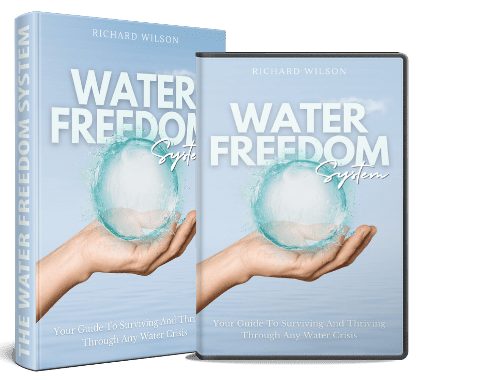
Get the full step-by-step blueprint, diagrams, parts list and video guides — plus the four bonus guides — with a 60-day money-back guarantee via ClickBank. Read the manual first, price the parts, check your humidity, and decide with your eyes open.
YES — CLAIM MY 73% DISCOUNT →Digital guide · Instant download · 60-day guarantee · Secure ClickBank checkout